
Tech Mahindra was the top loser in the Sensex pack, shedding over 3 per cent, followed by NTPC, IndusInd Bank, Kotak Bank and Reliance Industries. NSE Nifty fell 185.60 points to 17,671.65.

The markets may be entering a consolidation phase and are expected to trade sideways for now after a good run in the last few weeks, suggest analysts. In this backdrop, they suggest investors can book profits at the current levels and enter the market again on a decline from a medium-to-long term perspective. Thus far in fiscal 2023-24 (FY24), the S&P BSE Sensex has moved up around 5 per cent to nearly 62,000 levels.
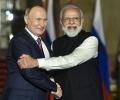
'A lot has been done under the leadership of PM Modi. He is a patriot of his country. His idea of 'Make in India' matters both economic wise and in ethics. Future belongs to India, it can be proud of the fact that it's the largest democracy in the world,' the Kremlin said at Valdai Discussion Club.

The Saudi and Iraq offer to replace Iranian crude supplies comes with a catch: Higher prices for the same quality of crude. The new government will face a tough decision over fuel price hike, says Aveek Sen.
Sensex, Nifty have lost about 6%, against 0.5-5% decline in other key Asian indices.

Should candidates for particular positions in the government be permitted to agitate for changing the recruitment process itself? The candidates have to meet the requirements of the jobs rather than ask for their own standards to be accepted as the requirement of the jobs. Those who cannot meet those criteria should seek other jobs that match their skills, says T P Sreenivasan.
Equity indices failed to hold on to their gains in see-saw trade on Tuesday, ending in the red for the third straight session despite a tentative recovery in global equities. The rupee too bounced back from historic lows, but the overall sentiment remained risk-averse amid concerns over economic recovery in a high interest rate scenario. The 30-share BSE Sensex had a choppy start but gained momentum in mid-session trade. However, it succumbed to selling pressure towards the fag end to close 105.82 points or 0.19 per cent lower at 54,364.85. On similar lines, the broader NSE Nifty declined 61.80 points or 0.38 per cent to finish at 16,240.05.

The RBI's financial stability report has on Wednesday highlighted the disconnect between the real economy and equity market yet again. The central bank observed that Indian equities were trading at rich valuations, with several metrics such as price to earnings multiples, price to book ratio, market cap to GDP and the cyclically adjusted P/E ratio, or Shiller P/E, at above historical averages. For instance, as on December 13, the one-year forward P/E ratio for India was 35.1 per cent, above its 10-year average, and one of the highest in the world.

A sharp sell-off in the Indian equities markets after a spike in crude oil prices should not be surprising. Historically there is a negative correlation between stock valuations in India and the price of Brent crude oil, which is the benchmark for the Indian crude oil basket. Between 2011 and 2014, crude oil traded above $100 a barrel for an extended period, the Sensex-trailing price/earnings (P/E) was 18X, on average, during the period, nearly 22 per cent lower than the current index P/E of 23X.

Forex dealers said besides strong demand for the American currency from importers, capital outflows mainly weighed on the domestic currency.

Shivaji made sure that his soldiers respected the sanctity of mosques and the Quran Sharif to ensure that his fight against the Mughals did not become fight against Islam, explains Colonel Anil A Athale (retd).

Materials and utilities were the worst-performing sectors in March.

'You know the kind of force involved in all of this. They are not good for the country where all of this will happen.'

'This fall is nothing. We could see worse if everybody hits the panic button.'

The broader NSE Nifty closed below the 10,600 mark by plunging 98.15 points, or 0.84 per cent, to 11,582.35 after shuttling between 11,567.40 and 11,751.80.

Global trends, WPI inflation data for April and the ongoing quarterly earnings of corporates would be the major driving factors for the stock markets, analysts said. Investors would also keep a tab on the movement of foreign institutional investors who are on a selling spree in the domestic equity market for the past many days. "Inflation concern and monetary tightening across the globe are key concerns for the equity markets. "Equity markets are under the strong grip of bears however they look extremely oversold and due for a pullback rally.

Although the Malabar is a routine exercise which has been carried out for several years now, security experts attach a lot of traction to it in view of China's assertive behaviour in the South China Sea, observes Rup Narayan Das.

'Recent underperformance notwithstanding, equities should constitute a major part of investors' financial portfolio.'

Ajit Balakrishnan on keeping an eye on democratising finance in India.
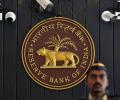
The Reserve Bank of India (RBI) is precariously balancing two opposing objectives - maintaining easy financial condition in the domestic market, while ensuring external stability - and economists have started taking note. They say India is going through the classic trilemma of the 'Impossible Trinity'. The RBI cannot have an independent monetary policy (setting domestic interest rates) in an environment of an open capital account and flexible exchange rates. What is even more complicated for the central bank now is that financial market stability overlays all the other three objectives.

Dr Rakesh Mohan, former RBI deputy governor, and Dr Pronab Sen, former chairman of the Indian Statistical Commission discuss the issues facing the Indian rural and manufacturing sectors and what the government must possibly do to improve demand and perk up the Indian economy

Since the 1984 national elections, no party has won a clear majority in the lower house of Parliament, a US intelligence report has observed. Vicky Nanjappa reports.
COVID-19 forced people to work from home turned into the fuel for new demat accounts, observes Debashis Basu.

The 30-share Sensex ended down 30.30 points at 28,161.72 and the 50-share Nifty dipped 7.95 points at 8,543.

Addressing party MPs at the general body meeting of the Congress Parliamentary Party in the central hall of Parliament, she said when facing a significant national challenge, it has been the tradition in our country to bring Parliament into confidence.

Market experts attributed the huge sell-off to weakness in Indian currency.

'India's edtech and start-up story will be in danger.'

A theory that is doing the rounds is that with election nearing, this depreciation of the rupee will allow politicians of all hues to bring back their ill-gotten wealth.

'If the third wave of Covid infections is as bad as the second one, the market may get very polarised with a preference for blue-chips with low volatility.'

Young investors could allocate in the proportion of 70:20:10 to equity, debt and gold.

Yes Bank was the top gainer in the Sensex pack, rallying up to 8.44 per cent, followed by Maruti, PowerGrid, NTPC, L&T and SBI.

'He is seeking to harness the power of Indian Diasporas to national (support for India in global capitals) and political (enhance the Bharatiya Janata Party's support base) ends.'

But their trajectory and direction have been largely influenced by politics and the political leadership's understanding of how the economy needs to be managed, explains A K Bhattacharya.

'The uneducated think of their rights as a gift. This is deeply troubling.' 'If they were educated they could claim what is rightfully theirs.'

At close, the Sensex was up seven points at 24,556 and the Nifty gained 11 points to end the session at 7,330.
